Baltimore & Maryland
Therapy for Dating
Challenges
Dating is tougher than it seems from the outside and sometimes
it’s not obvious why it’s not working out the way you wanted.
Reasons people seek therapy for dating:
You're not alone. Many of our clients come to therapy for support with:

Relationships ending at a similar point

Anxiety prior to, during, and after dating
Attracted to partners who are not available

Losing themselves in a relationship

Losing interest when things get serious

Rejection
sensitivity

Little to no dating experience

Dating app
burnout

Wanting closeness but struggling with it

Anxiety about sex with a new partner
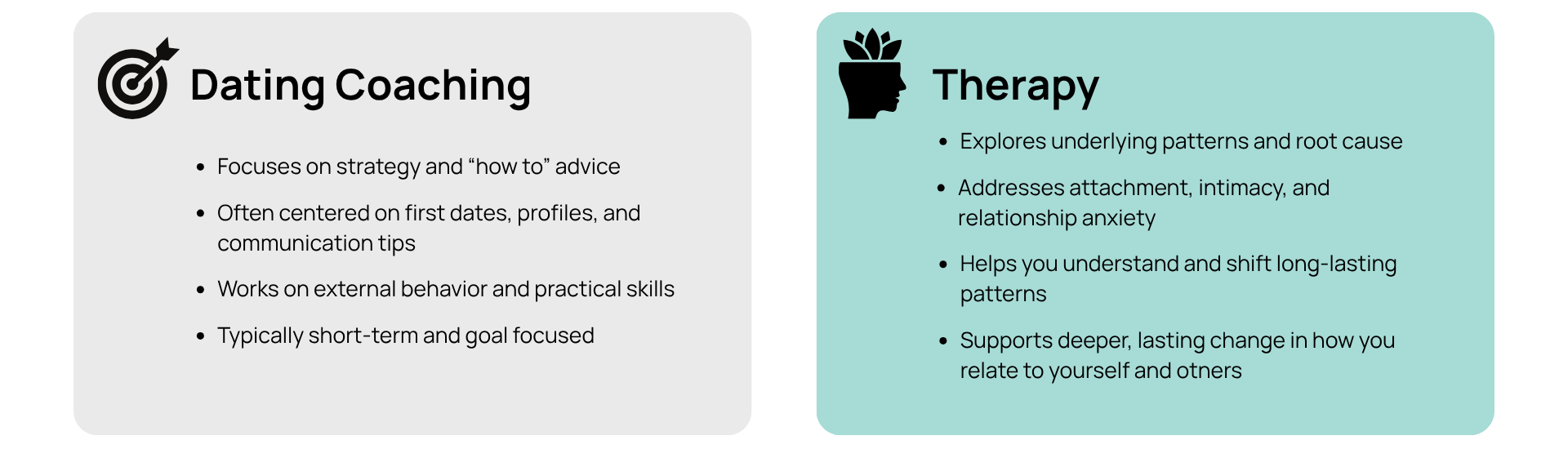
How This Is Different Than Dating Coaching
Both can be helpful – they just serve different purposes.
Observe the Pattern
When the same thing happens over and over again in different relationships there is usually something more useful going on than just bad luck.
A lot of it has to do with attachment patterns, the ways we learned, early on, to stay close to the people who mattered to us. If closeness meant unpredictability, one person might learn to watch for distance and reach harder when they felt it. If closeness meant a lot of expectations, then maybe the other one would learn to leave a little space around themselves. Both are reasonable adjustments. Either one can be a confusing thing to run into on a fourth date.
We operate from an attachment-based framework informed by EFT, the same model we use in our couples work. For you, it means less focus on technique, and more focus on what closeness means to you, what you usually do
The point where it becomes something you can choose about is usually when you recognize the pattern as it’s happening.
When the Problems in Dating Are Sexual
For many people, the hardest part of dating is the emotional side of sex — worry rooted in past experiences, or fear about what might go wrong in the future. It’s more common than people realize, and it’s very workable.
CICC is one of the few practices in the Baltimore area with both EFT and AASECT sex therapy certification, so this can be treated by a trained specialist as part of the same overall therapy — not as a separate issue.
We hear concerns like: erectile difficulty or performance anxiety with new partners; pain or difficulty with penetration; trouble reaching orgasm with a partner; low desire; self-consciousness that makes intimacy hard; first sexual experiences later in life; private questions about orientation; past experiences that felt frightening or unwanted; and how to talk to a new partner about any of this.
We talk all of this plainly and clinically and there is nothing about a first conversation that requires having the language ready beforehand.
What to Expect
A supportive, collaborative process tailored to you.

Assessment
We’ll get to know you, your concerns, and what you’d like to work on.

Relationship History
We’ll explore your past experiences and identify recurring patterns.

Noticing the Pattern
You’ll learn to recognize your patterns in the moment and understand what’s underneath.

Address Root Causes
We’ll work on anxiety, depression, trauma, or other concerns that may be impacting your dating life.
Ongoing Support
Meet weekly for 50-minute sessions, in person in Pikesville, MD or online across Maryland.
Frequently Asked Questions
Yes. It’s a one-on-one process looking at relational patterns – what closeness tends to feel like, what happens around rejection or commitment, how that influences who you’re drawn to and what happens from there. It’s the same clinical work that helps people in long-term relationships, just applied earlier.
Coaching is about dating behavior: profile, approach, strategy. Therapy works on the underneath, when there’s a pattern that goes on no matter what you do. If the problem is getting to a first date, coaching may be a better fit. If relationships tend to end at the same place, or closeness itself is the harder part, that’s work of a clinical nature. We’re licensed therapists, not offering coaching services.
Often, and more often than it seems from the outside. Long gaps, limited dating history, and no dating history at all are all common reasons people come in. It's familiar territory for our therapists.
That's one of the most common reasons people start. Who we're drawn to is rarely random — it usually tracks something familiar. The work is understanding what that familiarity is, so it becomes something you can recognize early rather than later on.
Yes. Our practice holds AASECT certification in sex therapy, which is unusual in the Baltimore area, so this can be addressed directly rather than referred elsewhere.
Fees vary by clinician and are listed on our team page. CICC is out-of-network — we don't bill insurance directly, but we provide receipts for out-of-network reimbursement, and many FSA and HSA accounts cover therapy. The 15-minute consult is free. Telehealth is available throughout Maryland; Mark Goldberg, LCMFT, CST is additionally licensed in New York. Our therapists work with clients of all genders, orientations, and relationship structures.
A good place to start.
Free 15-minute phone consult. No insurance to sort out, no commitment.