
You have tried cheer them up, give them space, plan things for them to do and look forward to and not saying anything at all. There are days when none of it seems to get through to them and you wonder if you are helping or making it worse.
Living with a depressed partner is one of the loneliest experiences in a relationship, in part because who you turn to normally is the person who is struggling.
In this article, we’ll discuss how depression impacts a relationship, why loving responses often go awry, and how couples therapy in Maryland can help the two of you regain your connection while your partner receives treatment for the depression itself.
Table of Contents
How Depression Impacts a Relationship

Depression alters the behaviors on which a relationship is built. Withdrawal, irritability, exhaustion, and loss of interest in things that used to bring pleasure affect the partner directly, whether or not either person names the cause.
Relationships that have quietly shrunk are often described by couples. The conversation gets shorter, plans stop being made, the sex dies down and the household work gets unevenly distributed to one person.
It’s not a side effect to ignore until the depression lifts, the strain on the relationship. Relationship distress and depression influence each other and treating only one often leaves the other in place.
Why do loving responses to a depressed partner sometimes backfire?
Depression dulls the response you’re looking for. One pattern therapists see often is one partner trying harder and harder to help and taking the flat response as rejection, not as a symptom.
This often means that one partner has the lead in practice: the schedule, the mood, the appointments, the children, the tone of the household. It’s generous. And it’s draining. And over time it can make the depressed partner feel like a burden or a patient rather than an equal.
The other response is to withdraw, to give space that is intended as respect but feels like abandonment.
Both responses are caring responses. Individually they don’t work very well. The depressed partner will see them through the lens that depression provides, which is usually one that confirms the belief that they are too much or not enough.
What Cycle Does Depression Create Between Partners?
Emotionally Focused Therapy (EFT) is an evidence-based couples therapy, grounded in attachment science, that focuses on the repeating emotional cycle two partners fall into when connection feels unsafe.
When depression is present, the cycle usually forms quickly. One partner withdraws because they have nothing left to give, the other pursues because the distance is frightening, and each response makes the other more likely.
Underneath the pursuit is usually fear rather than criticism, and underneath the withdrawal is usually shame rather than indifference. Neither partner can see that from the inside, which is why the cycle feels like evidence that the relationship itself is failing.
EFT works by making the cycle visible and slowing it down, so partners can say what is actually happening, such as “I feel like I am losing you” or “I am ashamed of what I have become,” rather than repeating the moves that keep it going. Read more about Emotionally Focused Therapy.
Does Couples Therapy Help When One Partner Is Depressed?
The research is promising, and it deserves to be described accurately.
A randomized pilot study published in the Journal of Marital and Family Therapy examined adding EFT to antidepressant medication for women with major depressive disorder who also had relationship distress. A later randomized controlled trial compared EFT with treatment as usual for depression and examined how change occurs.
A Cochrane review of couple therapy for depression found it was more effective than individual psychotherapy at reducing relationship distress, with the effect stronger among couples who were distressed. The reviewers also judged the overall quality of the evidence to be low and called for larger, better trials.
The practical takeaway is modest but useful. When depression and relationship distress occur together, working on the relationship is a reasonable part of the plan rather than something to postpone.
Is Couples Therapy a Substitute for Individual Depression Treatment?
No. Couples therapy addresses what depression is doing to the relationship. It does not replace individual treatment for the depression itself.
Most couples in this situation do best with both. That usually means the depressed partner has their own therapist, and decisions about medication stay between that partner and their prescribing provider.
We coordinate with those providers when a couple wants us to. What happens in the relationship is useful clinical information, and it often goes unreported in individual sessions.
If your partner is having thoughts of suicide, this is not something to work through alone. Call or text 988 to reach the 988 Suicide & Crisis Lifeline, available 24 hours a day.
What Happens to Sex and Intimacy When a Partner Is Depressed?
Sexual desire is one of the first things depression affects, and one of the last things couples talk about.
Loss of interest in sex is a recognized feature of depression, not a referendum on attraction. Some antidepressant medications can also affect desire, arousal, or orgasm, which is a conversation to have with the prescribing provider rather than a problem to endure quietly.
Meanwhile the other partner is often reading the absence of sex as the clearest available evidence that they are no longer wanted. That interpretation feeds the cycle described above.
Couples do not have to wait for the depression to resolve before addressing intimacy. Physical closeness that does not carry an expectation of sex often comes back first, and rebuilding from there tends to be more realistic than waiting for desire to return on its own. Learn more about our approach to sex therapy.
How Can I Support My Partner Without Losing Myself?
Supporting someone through depression is sustainable only if you are also a person with a life, not solely a caretaker.
Acceptance and Commitment Therapy (ACT) is an evidence-based approach that helps people act on their values even when difficult feelings are present. Applied here, it means continuing to do what matters to you rather than putting your life on hold until your partner feels better.
Mindfulness-based approaches help with a specific and exhausting habit: scanning your partner constantly for signs of how the day will go. Cognitive Behavioral Therapy (CBT), which targets the thought patterns that drive distress, is useful when your own thinking has turned toward blame, either of yourself or your partner.
Keeping your friendships, your work, and your interests is not selfish or a withdrawal of support. It protects the relationship from becoming entirely about the illness.
What If My Partner Will Not Go to Therapy?
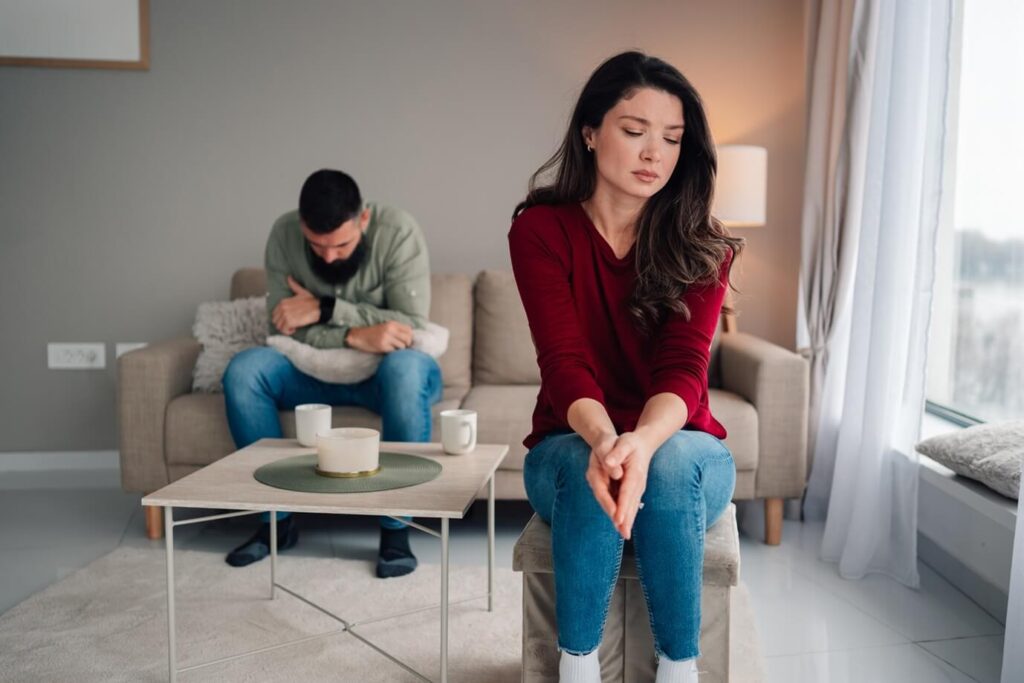
This is one of the most common questions we hear, and it has a more hopeful answer than most people expect.
Framing matters. An invitation to work on the relationship together often lands very differently from a suggestion that your partner needs fixing, particularly for someone already carrying shame.
Couples therapy can also be a lower barrier than individual therapy, because the focus is shared rather than centered on one person’s diagnosis.
If your partner still declines, your own therapy is worth pursuing. Changing your side of the cycle changes the cycle, and it frequently changes what your partner is willing to consider.
When Should Maryland Couples Seek Help?
There is no threshold you need to reach first. Useful signs that it is time include conversations that have narrowed to logistics, resentment that is becoming harder to hide, sex that has stopped without discussion, or one partner quietly wondering how long they can keep this up.
CICC was founded by Mark Goldberg, LCMFT, AASECT Certified Sex Therapist and EFT Certified Couples Therapist through the International Centre for Excellence in Emotionally Focused Therapy (ICEEFT). Our clinical team works with couples in person in Pikesville and by telehealth throughout Maryland.
Reaching out is not a verdict on your relationship or on your partner. It is a way to stop the two of you from carrying this alone.
A free 15-minute consultation is available to help determine the right fit and starting point with our clinical team. Learn more about our couples therapy services in Baltimore and Maryland or schedule your consultation today.
This article is for educational purposes and is not a substitute for individual medical or mental health care. Questions about diagnosis or medication should be directed to your own treating providers.