
It’s 2am and you’re wide awake. Not from noise or discomfort, but because your mind won’t stop. The talk you should have done differently. The thing at work that is not resolved. The relationship question with no right answer. The low hum of something wrong but you can’t quite say what it is.
For many people in Baltimore and across Maryland, disrupted sleep is not a sleep problem first. This is an anxiety problem, and it is most severe at night, when the distractions of daily life are gone and the mind turns to whatever has been waiting to be thought about. This is why treating the sleeplessness alone, by sleep hygiene tips or medication, often has limited results. The insomnia is a symptom. What it’s really about is the anxiety underneath it.
This article is for people in the Baltimore area who know their insomnia is caused by anxiety and want to understand what therapy can really do to get to the bottom of it.
Table of Contents
How Anxiety and Sleep Interfere with Each Other
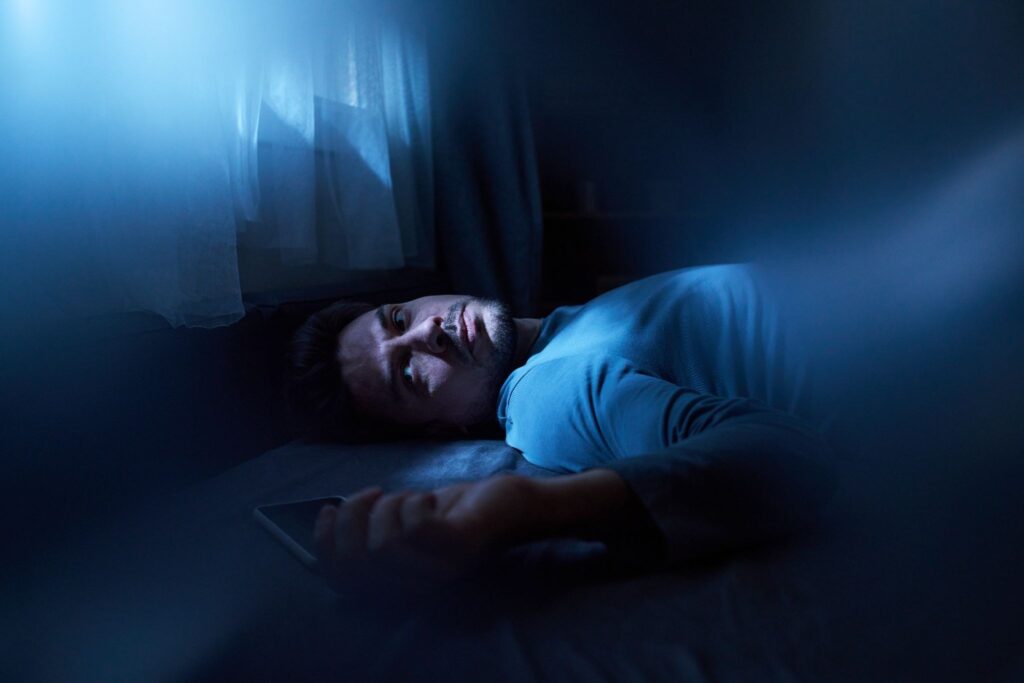
Anxiety and poor sleep are caught in a reinforcing cycle that is difficult to break without knowing how it works.
Anxiety triggers the threat-detection response of the nervous system, elevating cortisol and adrenaline and keeping the brain in a state of vigilance. Sleep, however, demands the opposite: a nervous system that has slowed down enough to allow the switch into rest. Chronic anxiety means that the nervous system rarely reaches that threshold. Sleep becomes elusive, shallow or repeatedly interrupted.
In turn, sleep deprivation increases anxiety. A tired brain has a reduced capacity for emotion regulation, reduced access to the functions of the prefrontal cortex that allow perspective and modulation, and a lower threshold for threat activation. Three hours of sleep makes the worries that a full night’s sleep seems to handle seem catastrophic.
The bed itself may also become associated with the experience of lying awake and feeling anxious over time, adding a conditioned level of arousal to an already disrupted system. That’s why so many people who suffer from anxiety-induced insomnia can fall asleep anywhere but in their own beds.
What the Mind Does While We Sleep
Part of dealing with insomnia is learning what kinds of thinking interfere with sleep. Anxiety-related insomnia usually takes one or more of the following forms:
Rumination
Cycling through past events, especially those involving conflict, perceived failure or things said and not said, in a repetitive fashion. Rumination is like problem solving but isn’t: it revisits the same material without resolution, creating distress without insight. It’s one of the strongest cognitive predictors of both depression and sleep disruption.
Catastrophization
The mind’s capacity to take a dicey situation and run it to the worst possible outcome. A tough conversation at work becomes a threat to the job. If there is tension in a relationship, it is evidence that it is failing. A bodily symptom becomes a serious illness. At night, without the moderating influence of the day’s activity and social interaction, catastrophizing goes unchecked.
Concerns about the future
Anticipatory anxiety: the rehearsal of things that haven’t happened, and may not happen. Money stress. Relationship doubts. Parenting fears. Health fears. The night mind spins elaborate scenarios about these concerns with a vividness and urgency that the day mind would be quicker to dismiss.
Anxiety about relationships
Relational thoughts are, for many people, the most reliably sleep-disrupting. An unresolved conflict with a partner, uncertainty about where a relationship is, grief over a relationship that has ended or the accumulated weight of things left unsaid in a marriage. Relational anxiety is particularly strong at night because it’s about attachment and attachment worries trigger the nervous system at a deep level.
The Root Cause is Relationship Anxiety
The root of anxiety-induced insomnia is often found in the primary relationship. It is worth naming this directly as it is often what brings people to therapy at the Center for Intimacy, Connection and Change, even when they initially present with a seeming general anxiety or sleep concern.
Nighttime is when the weight of those problems is most acutely felt,” said couples caught up in conflict, emotionally disengaged, or harboring unspoken tensions. The partner beside you who seems so distant. The conversation that is always put off. If the relationship is headed where you want it to go.
In these instances, addressing the anxiety alone only tackles part of the picture. The source is the relational context and that is where you need to look.
Therapeutic Approaches That Attack Anxiety at its Core

The Center for Intimacy, Connection and Change in Baltimore provides anxiety treatment with a combination of evidence-based modalities, depending on the individual’s presentation.
Cognitive Behavioral Therapy CBT
CBT, trained by Beck Institute, targets the thought patterns that cause anxiety and interfere with sleep. This involves learning to identify and modify the patterns of catastrophizing and rumination that are triggered at night, developing cognitive tools to interrupt the chain of escalating anxiety, and addressing the behavioral avoidance that often develops around sleep itself. CBT has one of the strongest evidence bases of all interventions for anxiety disorders.
Acceptance and Commitment Therapy (ACT)
ACT has a different approach to anxiety. Rather than trying to get rid of anxious thoughts, it builds the ability to hold them without them controlling you. This is especially helpful for the kind of nighttime anxiety that’s driven by real uncertainty, real relationship concerns, or life circumstances that can’t just be thought away. ACT helps people to create room for discomfort without it dominating their functioning or their nights.
Mindfulness-Based Therapies
The practice of mindfulness is directly related to the nighttime anxiety cycle. Learning to see thoughts as thoughts, not facts to be acted on immediately, can create some distance from the rumination and catastrophizing that fuel sleeplessness. Mindfulness also works at the level of nervous system regulation, contributing to the downregulation that sleep requires.
Emotionally Focused Therapy (EFT) for Relationship Anxiety
When sleep-disrupting anxiety is primarily relational, EFT targets the attachment dynamics underlying it. Mark Goldberg’s EFT certification is particularly relevant here: EFT is one of the most evidence-based approaches for couples struggling with the kind of emotional disconnection and unresolved tension that most acutely manifests itself at night.
Things That Help In The Short Run
While therapy will target the root of the anxiety, there are a few practices that can help to lessen the intensity of nighttime anxiety in the near term.
Write it down before sleeping
Writing anxious thoughts down before bed decreases the cognitive load the mind carries into the night. It’s not journaling in the expressive sense, but it is a short, structured dump of whatever is going around: worries, unresolved items, things to address tomorrow. Writing tells the mind, “This information has been captured, you don’t need to keep it in active memory.
Intentionally delay worrying
A CBT trick: If an anxious thought pops up at night, don’t engage with it or try to push it away; acknowledge it and intentionally schedule it. I hear that. I’ll think about that tomorrow at 9 am. That seems almost too simple to be effective. It works better than it sounds because it gives the mind a legitimate out, rather than asking it to do the impossible task of just not thinking something.
Sleep time: Resolve relationship tension
Not necessarily resolving the conflict, which often is not possible in a single conversation, but recognizing it. A simple “I know things have been tense between us and I want us to talk about it this week” can lower the activation level of relational anxiety enough for rest to be possible. If you leave it totally unacknowledged, the tendency is to exacerbate the tension overnight.”
Frequently Asked Questions
How do I know if my insomnia is from anxiety or a sleep disorder?
The primary obstacle to sleep in anxiety-induced insomnia is often an active mind, racing thoughts, or repetitive thinking. You are tired, you want to sleep but the thoughts will not cease. Sleep disorders, like sleep apnea, have different mechanisms and usually require evaluation by a medical provider. If you struggle to sleep because you can’t stop thinking about everything and feel anxious then anxiety is probably the main cause rather than experiencing physical symptoms.
Will therapy for anxiety help me sleep?
Yes, anxiety-induced insomnia. When the anxiety that is activating the nervous system at night is addressed directly in therapy, sleep usually improves as a result. There is in particular a strong evidence base for this with CBT. The change may not be immediate as deeply entrenched thought patterns take time to shift but it is often more sustainable than sleep-based interventions alone.
My greatest anxiety is about the relationship. Do I do that in individual therapy or couples therapy?
Both are valid starting points. You can learn about your own patterns of anxiety, what they are connected to and how to work with them in individual therapy. Couples therapy addresses the relational dynamics that are creating the anxiety in the first place. Some start as individuals and move into couples work, others start as a couple. CICC works with individuals and couples on these concerns.
Where are you located? Are you doing telehealth in Maryland?
CICC is based in Pikesville, Maryland, and serves the greater Baltimore area including Towson, Owings Mills, Reisterstown and Baltimore County. Telehealth sessions are available throughout Maryland for individuals and couples who prefer to meet virtually or live farther from the Pikesville office.
Anxiety at CICC Baltimore: How to Handle It
Center for Intimacy, Connection and Change is a specialty therapy practice located in Pikesville, Maryland. Mark Goldberg, LCMFT, works with individuals and couples struggling with anxiety (including the relational anxiety that most often hits at 2AM) using CBT, ACT, mindfulness-based therapy, and EFT.
If you have thoughts that keep you awake at night, that therapy could help you work through at the source, free 15-minute consultation available with no obligation.